Week 1:
Introduction and Themes in Russian History
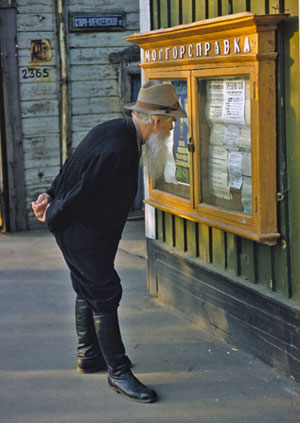
Soviet citizen reading the news/announcements. These informational galleries (spravka) were usually located throughout the city and were a place where people could go and read the newspaper, or other information, that was posted there.

- Read the textbook chapters 1 and 2.
- Review ELI policies and procedures and the course requirements for this course. Check out all of the course assignments and materials. Pay particular attention to the details of the midterm and final exams.
- Have a look at the professional credentials (Professor Blois and Professor Evans) and introduction letters (Professor Blois and Professor Evans) of your instructors.
- Check the remarks by Professor Blois and Professor Evans on studying Russian history.
- Study the Questions to Consider and the Key Terms for the week
- Since the use of proper grammar, spelling and style are an inherent part of each assignment in this course, please check the course writing resources available in Charlie's History Writing Center for more information.
- Submit the introduction paragraph
- Take the Course Introduction Check quiz. Log into Blackboard and you will see the button for the quiz in your course. This is a short, 10-question orientation quiz that you must take and pass with a score of 9/10 before you can continue in the course. If you must, you can re-take the quiz more than once. The quiz is also worth 10 points of extra credit.
- Watch the short video on developing a time management schedule for your course work.
- Post an informal hello in the Blackboard online discussion forum. Please review the instructions for Using Blackboard, if necessary.
- You may also wish to glance at my interactive lecture on Russian geography and then return to it later in the course. There is also available on the web a lecture by the late Professor Michael Boro Petrovich on Russian Geography.
- I sometimes post additional remarks relevant to this course on my Russian History blog that you can check.
- If you wish, you can bookmark the Chronology of Russia website, which you will find very useful for keeping track of important historical dates.
- Watch the short clip of the Medieval Help Desk about some problems that medieval monks faced with the transition from using scrolls to reading books. Log into Blackboard and check for it under course materials.
- Read chapter 1 from Mary Platt Parmele (1843-1911) A Short History of Russia (1907, 4th edition). I will include some excerpts from this old textbook throughout the course, since Parmele provides a rather standard (and interesting) impression of Russian history from the early twentieth century, before the Bolshevik Revolution. This is optional reading. If you wish, you can download the entire book.
- Another good overview of Russian history, up to about 1910, is H. W. Williams, Russia of the Russians (New York: Charles Scribner's Sons, 1915), especially his chapter, "The Growth of Russia." Williams was a newspaper correspondent in Russia who married a politically-active Russian liberal woman. His book, though almost a century old, is well-written and very much reflective of pre-World War I sentiments.
- You can check out my quick list of course resources which contains links to all of my supporting web pages for HIS 241.
- Finally, you can also have a look at my page of selected general resources
applicable to your study of Russian history. The page includes
online map resources, recommended textbooks, resource websites, etc.
- For 25 points of extra credit, review this entire course website, check the online ELI student orientation and send your instructor any questions that you might have. This must be done in weeks 1 or 2 of the course to receive credit.
- You can also earn extra credit at any time by (a) finding a typo, spelling error or broken link (and sending me that information) or (b) finding any website or web materials that are relevant to this course. (Send the title of the site, the url and a brief explanation why you find the information interesting and applicable to the course.)
- Other opportunities for extra credit?
- Suggest an assignment for use somewhere in the course. Be creative!